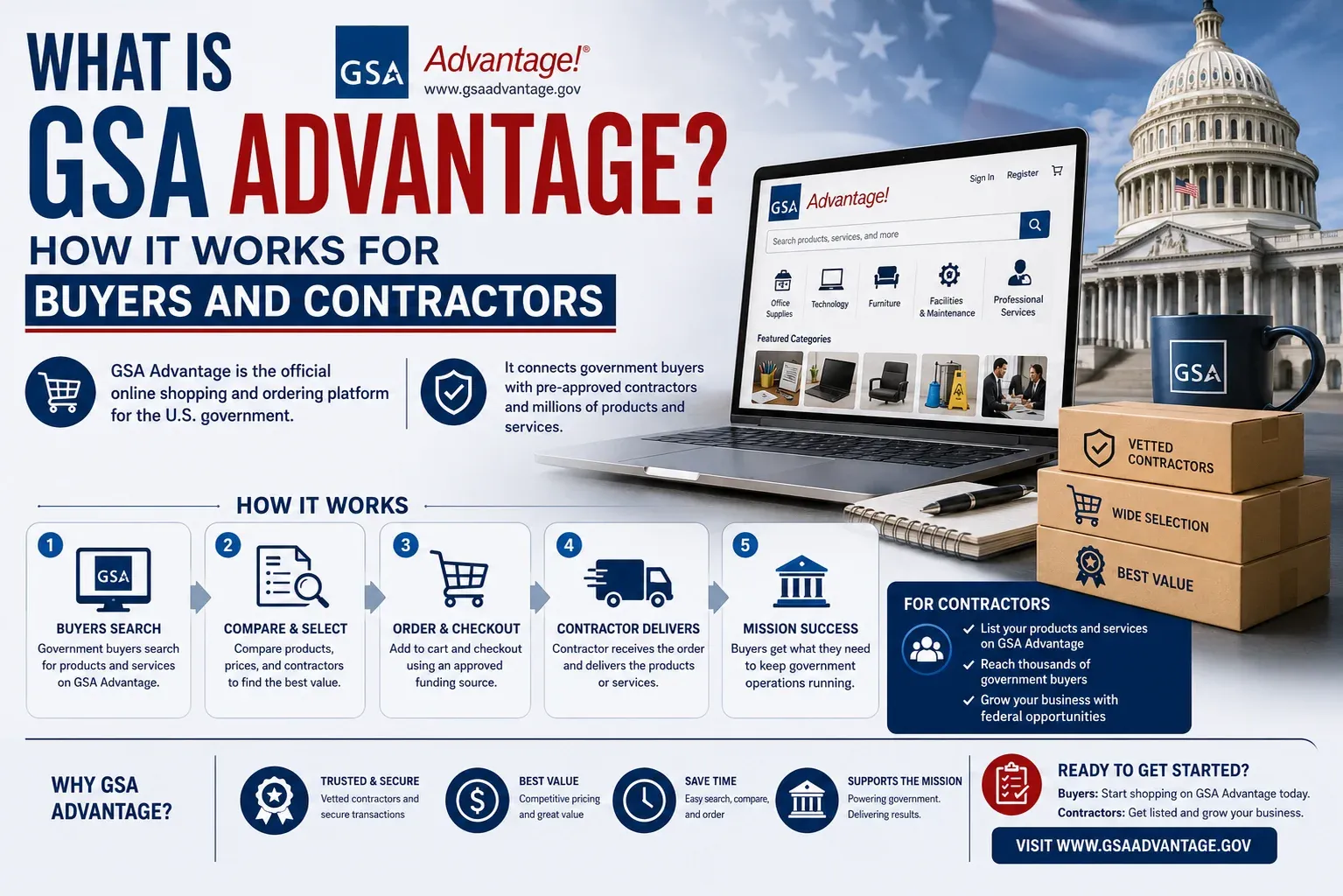
The U.S. federal government spends over $700 billion annually on products and services. A significant share of that purchasing runs through GSA Advantage, the federal government’s official online marketplace.
The U.S. federal government spends over $700 billion annually on products and services. A significant share of that purchasing runs through GSA Advantage, the federal government’s official online marketplace. For contractors, getting listed on the platform opens direct access to thousands of government buyers across every agency in the country.
This guide explains what GSA Advantage is, what government agencies can buy there, who is authorized to purchase through it, how the ordering process works, and how contractors get listed.
What Is GSA Advantage
GSA Advantage is an online purchasing marketplace operated by the U.S. General Services Administration. The platform lets authorized government buyers browse, compare, and purchase products and services from pre-approved contractors without going through a full open-market procurement process. Pricing and contract terms are already negotiated under the GSA Schedule program before any listing goes live, which is what makes the platform faster and more efficient than standard federal acquisition.
The General Services Administration runs GSA Advantage through its Federal Acquisition Service (FAS), which manages the GSA Schedule Program. That program connects government agencies with vetted contractors through pre-negotiated Multiple Award Schedule (MAS) contracts. Each contractor’s products and services are categorized under Special Item Numbers (SINs), which define exactly what a contractor is approved to sell. A contractor can only offer items that fall within the SINs awarded under their contract.
GSA Advantage is often compared to Amazon for government procurement, and the comparison is accurate in terms of structure. Buyers can search by product, compare vendors, review pricing, check delivery terms, and place orders in a single session. The key difference is that every seller on the platform has already cleared a federal contracting process, and every price has already been approved as fair and reasonable for government use.
GSA Advantage vs. GSA eBuy: Understanding the Difference
While GSA Advantage handles catalog-based purchasing, the platform is not designed for every type of federal acquisition. Larger and more complex requirements move through GSA eBuy, a companion platform where agencies post Requests for Quotes (RFQs) and contractors under GSA Schedule contracts submit competitive proposals. GSA eBuy is the right channel for customized work, higher-value services, or requirements that go beyond a standard catalog order.
Government buyers also use GSA Advantage for market research before issuing a formal solicitation. Agencies can review contractor capabilities, compare pricing structures, and identify qualified vendors through the platform before deciding how to structure a procurement.
What Agencies Can Buy on GSA Advantage
GSA Advantage covers nearly every category of product and service a federal agency might need. The platform organizes purchasing into major categories including building and industrial supplies, electronics and technology, law enforcement and security equipment, janitorial and sanitation products, office supplies and equipment, scientific and medical supplies, maintenance and repair materials, furniture and furnishings, vehicles and transportation equipment, and professional services.
Within those categories, agencies purchase a wide range of items. IT hardware, cybersecurity solutions, laboratory equipment, medical supplies, flooring materials, industrial tools, telecommunications systems, and food service equipment are all available through approved GSA Schedule contracts. The platform also supports professional and specialized services such as consulting, project management, engineering support, and technical solutions.
Beyond standard purchasing, GSA Advantage supports several specialized programs. GSA Global Supply helps agencies purchase everyday operational items including office supplies and maintenance equipment. The Disaster Recovery Purchasing program lets state and local governments access emergency preparedness and disaster recovery supplies from approved vendors. Agencies can also use the platform’s Contractor Information Tools to review award details, pricing catalogs, and service files for more complex procurements.
Government buyers frequently use GSA Advantage for purchases under the micro-purchase threshold, which is generally $15,000 for most federal purchases. Some categories have lower thresholds. Construction subject to the Davis-Bacon Act carries a $2,000 threshold. Certain service contracts set the limit at $2,500. Emergency and contingency situations may permit higher thresholds depending on the acquisition type.
Who Can Buy Through GSA Advantage
Federal government buyers are the primary users of GSA Advantage. Anyone from the public can browse the marketplace, but only authorized buyers with approved credentials can place orders. The platform uses government purchase cards and agency billing codes to process transactions.
Federal agencies across all three branches of government are authorized to purchase through the platform. This includes executive branch agencies and departments, legislative branch organizations, judicial branch entities, government-owned corporations, and federal contracting offices. Agencies such as the Department of Defense, the Central Intelligence Agency, and the U.S. Postal Service all use GSA Advantage for routine purchasing.
State and local governments can also purchase through GSA Advantage under specific programs. The Cooperative Purchasing Program gives eligible state and local governments access to information technology, cybersecurity, security systems, and law enforcement equipment from GSA Schedule contractors. The Disaster Recovery Purchasing Program extends access to emergency preparedness supplies and recovery materials during major disaster events.
Authorized tribal governments and tribal organizations can purchase through the platform for mission-related needs. This includes organizations operating under the Indian Self-Determination and Education Assistance Act (ISDEAA) and the Native American Housing Assistance and Self-Determination Act (NAHASDA). Eligible educational institutions, including public school systems, community colleges, and approved universities, also have purchasing authority under designated programs. Certain nonprofit organizations involved in emergency response or public support services, including the American Red Cross, are authorized buyers as well.
Other authorized entities include the District of Columbia government, U.S. territories such as Puerto Rico, Guam, and the U.S. Virgin Islands, mixed-ownership government corporations, and certain federal contractors operating under approved contracts.
All purchases must be made using official government-approved payment methods. GSA SmartPay cards are the most common payment instrument. Personal purchases are not permitted on the platform.
How Ordering Works on GSA Advantage
Ordering through GSA Advantage follows a structured process similar to a standard e-commerce platform, but restricted to verified government buyers and designed specifically around federal acquisition requirements.
Step 1. Register and Log In
Only authorized government buyers can place orders. Eligible users log in with approved GSA Advantage credentials. Accounts are typically linked to a Government Purchase Card (GPC), an Activity Address Code (AAC), or a Department of Defense Activity Address Code (DoDAAC). These identifiers connect orders to the correct agency billing and procurement tracking systems.
Step 2. Search and Compare
Buyers search the marketplace using keywords, product names, manufacturer details, National Stock Numbers (NSNs), contractor names, or product categories. Search results display pricing, features, delivery timelines, warranty terms, and contractor information side by side. Buyers can add items to a digital cart, save carts for future purchases, or share carts with team members for internal review before checkout.
Step 3. Check Out and Pay
The buyer finalizes the order and payment processes through a Government Purchase Card, a direct agency billing system, or an AAC or DoDAAC payment method. The system generates a purchase order and sends it directly to the selected contractor once payment is authorized.
Step 4. Receive and Track the Order
The contractor receives the order through the GSA Purchase Order Portal and must officially accept it before processing begins. After acceptance, the contractor prepares and ships the order, uploads shipment details and tracking information into the system, and the buyer monitors status through the platform. Once delivery is complete according to contract terms, the order closes.
Ordering Services Through GSA Advantage
Service procurement on GSA Advantage works differently from product purchasing. Government agencies commonly use the platform to research service providers, compare contractor capabilities, and review pricing before making a decision. For larger or more specialized service requirements, agencies typically contact contractors directly, request quotes, or route the requirement through GSA eBuy rather than checking out online.
How Contractors Get Listed on GSA Advantage
Contractors cannot sign up for GSA Advantage like a commercial marketplace. First, they must secure a contract through the federal government, most commonly through the Multiple Award Schedule (MAS) program. The full process from application to active listing typically takes 6 to 12 months depending on business readiness, documentation quality, and negotiation timelines.
Phase 1: Obtain a GSA Schedule Contract
Before any listing appears on GSA Advantage, a business must hold a formal contract with the federal government.
The first step is registering in SAM.gov to receive a Unique Entity Identifier (UEI). During registration, businesses select the NAICS codes that define their industry and service categories. Without an active SAM.gov registration, a business cannot participate in any federal contracting program, including GSA Schedules.
Next, the business submits a proposal through the GSA eOffer system. That proposal includes past performance records, financial documentation, technical capability statements, and a detailed pricing list. A GSA Contracting Officer then reviews the proposal and negotiates pricing to confirm it meets government fair and reasonable standards. This is a mandatory step. GSA will not award a contract without completing pricing negotiations.
Once the negotiation is complete and the proposal is approved, the contractor receives a GSA Schedule contract number. That number is required to access GSA procurement systems, including GSA Advantage.
Phase 2: Upload and Publish the Catalog
After receiving the contract award, the contractor must publish a product or service catalog within 30 days. Missing this window can delay market entry and may require additional coordination with the GSA Vendor Support Center.
The contractor first registers the awarded contract with the GSA Vendor Support Center (VSC), which manages onboarding and catalog activation. Catalog uploads go through the FAS Catalog Platform (FCP), which is the mandatory system for new contractors. A legacy system called the Schedule Input Program (SIP) is available in limited cases for existing contractors.
Each catalog entry must include a product description between 10 and 1,000 characters, at least one high-quality product image under 1 MB, pricing that includes the Industrial Funding Fee (IFF), and detailed delivery terms and conditions. The IFF is currently 0.75% and represents the contractor’s contribution to GSA contract administration costs. All prices submitted to the platform must include this fee.
A Contracting Officer reviews the uploaded catalog for compliance before it goes live. Once approved, listings publish automatically to the GSA Advantage storefront.
How to Stay Active on GSA Advantage After Approval
Getting listed is not the finish line. Contractors must meet ongoing compliance standards to remain active. Every listing must clearly identify the manufacturer name, part number, and country of origin. Product descriptions must be factual and free from promotional language. At least one high-quality image is required per item. Pricing must remain transparent, with delivery terms clearly defined.
Beyond catalog management, contractors must submit regular sales reports to GSA, pay the Industrial Funding Fee on all GSA Advantage sales, file contract modifications any time pricing or catalog details change, and complete periodic contract renewals to stay active under the GSA Schedule program. Failing to meet these requirements can result in contract termination and removal from the platform.
Once approved and active, GSA Advantage gives contractors direct access to one of the largest and most stable purchasing marketplaces in the U.S. federal system. Government buyers across thousands of agencies can find, compare, and order directly from an approved contractor’s storefront without any additional procurement steps.