You want to scale your business. Commercial clients often provide unpredictable revenue, and managing fluctuating cash flow takes massive energy.
The U.S. federal government solves this problem entirely. They spend hundreds of billions of dollars every single year on products and services exactly like yours. Mastering how to bid on federal contracts unlocks the most reliable, recession-proof revenue stream in the world.
This guide provides your complete roadmap. We show you how to find lucrative opportunities, navigate the strict requirements, and write offers that bring you wins
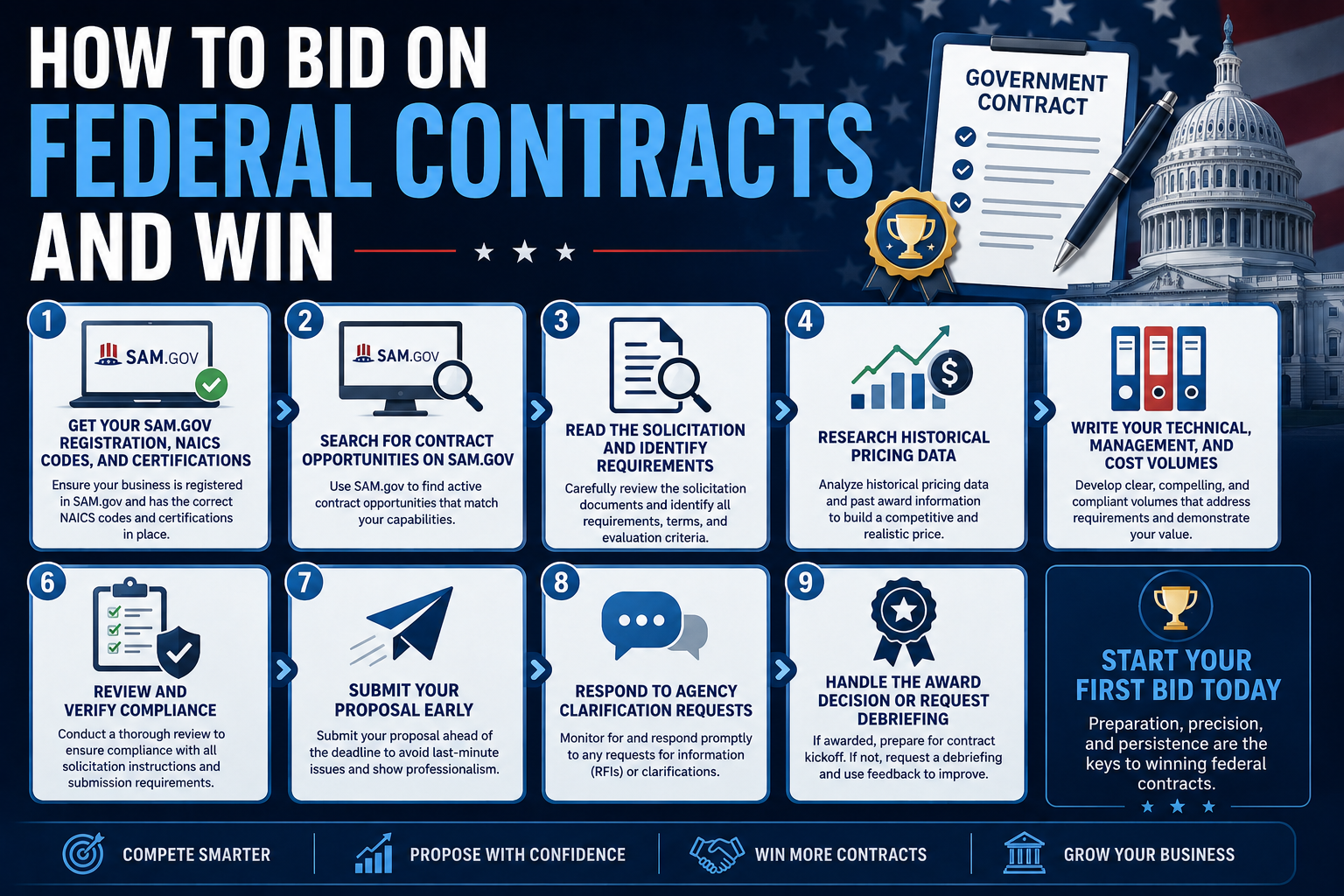
Step 1: Get Your SAM.gov Registration, NAICS Codes, and Certifications
You cannot bid without SAM.gov registration. The System for Award Management is the official federal contractor database. Registration is free and takes 10 business days.
Complete These Five Registration Steps:
- Create a Login.gov account with government ID verification
- Request your Unique Entity ID in the SAM.gov portal
- Enter tax ID and banking information (must match IRS records exactly)
- Input your NAICS codes and business capabilities
- Complete representations and certifications
Find Your NAICS Codes
NAICS codes are six-digit numbers that define what you sell. Most businesses qualify for 3-7 codes. Find yours at the Census Bureau NAICS search tool. The government uses these codes to organize every contract opportunity.
Apply for Small Business Certifications
Small business certifications reduce competition dramatically. Set-aside contracts attract 3-5 bidders instead of 15-20 for open competitions. Four main programs exist:
- 8(a) Business Development Program for disadvantaged businesses
- Women-Owned Small Business (WOSB) for businesses 51%+ women-owned
- Service-Disabled Veteran-Owned Small Business (SDVOSB) for businesses 51%+ veteran-owned
- HUBZone for businesses in historically underutilized zones
Check your eligibility at the SBA certification programs page.
Mark Your Renewal Date
Your SAM registration expires after 365 days. An expired registration disqualifies you from evaluations and blocks contract payments. Set a calendar reminder 60 days before expiration, and if you need help to renew it read : How to renew sam registration
Step 2: Search for Contract Opportunities on SAM.gov
Log into SAM.gov and select Contract Opportunities from the menu. Search by your NAICS codes for the most relevant results.
Apply These Key Filters:
- Set-aside type – Shows only contracts matching your certifications
- NAICS code – Displays contracts in your registered industries
- Place of performance – Filters by geographic location
- Response deadline – Agencies typically allow 30-45 days for proposals
Set Up Automated Alerts
Save your configured search with a descriptive name. Enable daily email notifications. The system sends one consolidated email each morning listing new opportunities that match your criteria.
Step 3: Read the Solicitation and Identify Requirements
When you find a target opportunity, download the complete solicitation package. These typically run 50-200 pages. Read the entire document before deciding to bid.
Focus on Section L – Submission Instructions
Section L contains submission instructions. It specifies:
- Page limits for each volume (typically 20-30 pages for technical)
- Required font and size (usually 12pt Times New Roman)
- Margin widths (usually 1 inch)
- Mandatory forms you must include
- Submission deadline in Eastern Time
Create a checklist of every Section L requirement. Missing one item disqualifies your entire proposal.
Study Section M – Evaluation Criteria
Section M explains how the agency scores proposals. It lists evaluation factors and their weights. Example breakdown: Technical Approach 50%, Past Performance 30%, Price 20%.
Section M also defines the evaluation method:
- LPTA (Lowest Price Technically Acceptable) – Meet minimum technical standards, then lowest price wins
- Best Value – Agency scores both technical quality and price, then selects highest combined score
Match your effort to Section M priorities. If Technical Approach receives 50% of the score, dedicate 50% of your effort to that volume.
Create Your Compliance Matrix
Read Sections C, L, and M carefully. Highlight every sentence containing “shall,” “must,” or “will.” These indicate mandatory requirements.
Create a compliance matrix in Excel with three columns: Requirement Text | Proposal Section | Page Number. Extract every mandatory statement. Update with page numbers as you write.
Step 4: Research Historical Pricing Data
Federal agencies publish historical contract prices in public databases. Use this data to price competitively.
Search USAspending.gov
Navigate to USAspending.gov Advanced Search. Filter by your target NAICS code and specific agency. Filter by award dates within the last 2-3 years for current pricing.
Download results as CSV. Calculate the average price for contracts similar in scope, duration, and location to your target opportunity.
Price Within the Historical Range
Winning bids typically fall within 10% of the historical average. Prices 20% above average rarely win unless you demonstrate extraordinary value. Prices 20% below raise evaluator concerns about quality or understanding of requirements.
Adjust for geographic location. DC metro area contracts run 15-20% higher than midwest locations due to labor costs.
Step 5: Write Your Technical, Management, and Cost Volumes
Federal proposals require three separate volumes. Each volume answers a specific question the agency needs answered.
Technical Volume – Show HOW You’ll Do the Work
Start by restating what the agency needs in your own words. This proves you understand the requirement. Then walk through your approach step-by-step. Explain exactly how you’ll complete each major task. Include when you’ll finish each phase. Identify potential problems and explain how you’ll prevent them.
Add diagrams to make complex ideas clear. Use flowcharts to show your process. Use org charts to show your team structure. Use timeline charts to show when tasks happen.
Management Volume – Show WHO Will Do the Work
Explain how you’ll manage the project. Name your project manager and describe their relevant experience. Explain how you’ll ensure quality work. Include one-page resumes for key team members focused on similar work they’ve done.
List 3-5 projects you have completed that are similar to this one. For each project, include the contract number, when you did it, how much it was worth, what you did, and a customer contact who can verify your work. One highly similar project is better than five loosely related ones.
Cost Volume – Show WHAT It Will Cost
Break down your price by labor hours, materials, travel, and other costs. The solicitation usually includes a pricing form in Section J. Use that exact form. Don’t create your own.
For labor costs, show your math: worker’s salary + benefits (30-35%) + your company overhead (40-60%) + profit (8-12%) = hourly rate.
Make sure your costs match your technical plan. If you say a task takes 500 hours in your Technical Volume, show 500 hours of cost in your Cost Volume.
Create Your Compliance Checklist First
Before you start writing, make a simple spreadsheet. List every requirement from the solicitation in column 1. Leave column 2 blank for now – you’ll add page numbers as you write. This ensures you don’t accidentally skip a requirement.
Writing a winning proposal requires careful attention to what the agency asks for and how they’ll score your response. For complete step-by-step instructions on building each volume, read our detailed guide on how to write a government proposal.
Step 6: Review and Verify Compliance
Most proposals get rejected for simple mistakes, not bad ideas. A careful final check protects all your hard work.
Check Your Requirements List
Open the spreadsheet you created in Step 5. Go through every “shall,” “must,” and “will” statement. Make sure you write about each one. Verify you wrote down the correct page number where you addressed it. If you find anything missing, add it now before you submit.
Double-Check Formatting
Count the pages in each volume. Make sure you didn’t go over the limit. Check your margins with a ruler if needed. Verify you used the correct font and size that Section L requires. Look at every mandatory form to confirm it has all required signatures.
Four Mistakes That Kill Most Proposals:
- Missing a required form – causes 40% of rejections
- Too many pages – causes 25% of rejections
- Submitting late – causes 20% of rejections
- Wrong file type – causes 10% of rejections
One small formatting error can disqualify an otherwise perfect proposal. Review everything twice.
Step 7: Submit Your Proposal Early
Never submit at the last minute. Technical issues happen during submission. File upload systems slow near deadlines. Internet connections fail.
Late proposals are rejected without review regardless of reason. One minute late equals disqualification. Give yourself 24-hour buffer time.
Step 8: Respond to Agency Clarification Requests
After submission, agencies conduct multi-phase evaluation over 6-12 weeks:
- Compliance screening (1-2 weeks)
- Technical evaluation (2-6 weeks)
- Past performance review (1-2 weeks)
- Price evaluation (1 week)
Answer Clarification Requests Promptly
The contracting officer may ask clarification questions during evaluation. These address minor issues, not major deficiencies. Receiving a clarification request means you remain in consideration.
You typically have 48-72 hours to respond. Keep responses brief and answer directly.
Step 9: Handle the Award Decision or Request Debriefing
Agencies announce awards on SAM.gov with contract number, period of performance, total value, and winner name. Winners receive direct email notification.
If You Win the Contract
Contract award triggers immediate administrative requirements including insurance verification, personnel security checks, and project kickoff planning. For complete guidance on the critical first 30 days, see our guide on what to do after winning a government contract.
If You Lose the Contract
You have 3 days to request debriefing from the contracting officer. The agency schedules it within 5 days. They explain your proposal’s strengths, weaknesses, and where the winner scored higher. They will not disclose the winner’s price.
Use this feedback to improve your next proposal. If they say your past performance lacked relevance, find more similar projects. If you missed a requirement, strengthen your compliance matrix process.
You can file a protest with the Government Accountability Office within 10 days if you have clear evidence of evaluation error. Protest success rate is 20-25%.
Start Your First Bid Today
Federal contracting rewards businesses that follow instructions precisely and demonstrate relevant capabilities clearly.
Begin with SAM.gov registration. While it processes over 10 days, identify your NAICS codes at the Census Bureau tool and set up opportunity alerts.
Read three solicitations in your industry before writing your first proposal. Study their Section L and M structures. Note common requirements across opportunities.
Build your first proposal using the compliance matrix method. Map every requirement before writing. This ensures you address every mandatory item and prevents disqualification.